Axel Becker
Debutant
NO
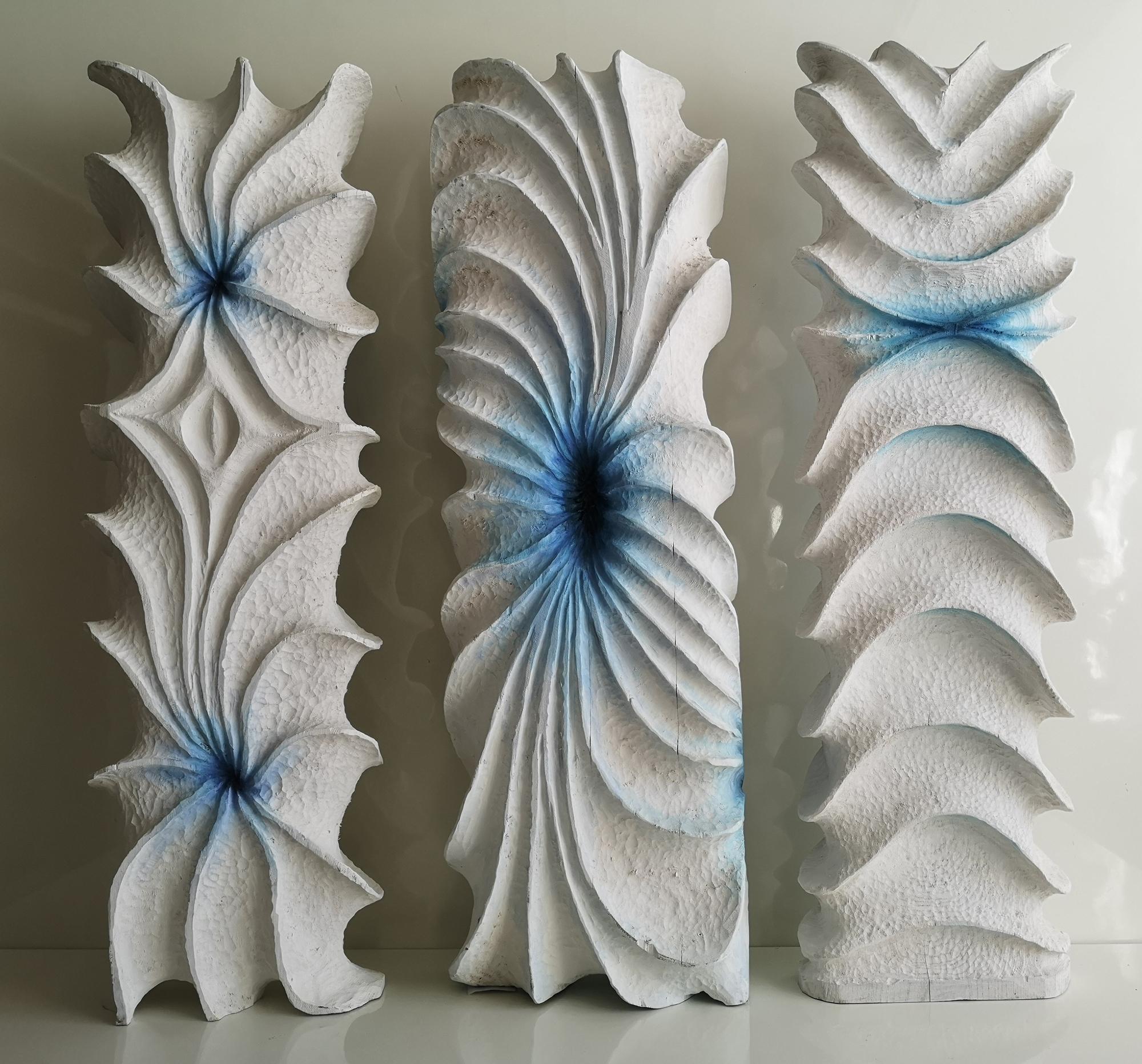
Mothers and Daughters (2026)
Bjørk, indigo, ca. 80 × 80 cm.
I Mothers and Daughters har jeg arbeidet med bjørk, som er skåret til omtrent like tykke planker. Verket består av tre deler: én «mor» og to «døtre», én på hver side. Delene står samlet, med litt avstand mellom seg, slik at verket kan sees fra begge sider.
Skulpturene bygger på en gammel tanke innen filosofi og religion, der mennesket lever i dualismer som dag og natt, godt og dårlig, varmt og kaldt, men kan søke mot enhet. Enhet med naturen, med skaperverket, med andre vesener og med seg selv.
På den ene siden har moren og døtrene to sentrale punkter i blått, der alle linjene kommer fra. Linjene snor seg rundt og samles i ett punkt på den andre siden. Slik blir overgangen fra dualisme til enhet uttrykt i form. Verket peker også på muligheten for en snuoperasjon: et nytt valg, eller en annen måte å se tingene på.
Axel Becker (f. 1951, Minden) bor og arbeider på Fosen i Trøndelag. Han er opprinnelig utdannet illustratør og grafiker, og arbeider med tekstil, stofftrykk, indigofarging, stein og tre. Materialene han bruker er ofte funnet, som vindfall fra skogen eller stein fra fjæra.
EN
Mothers and Daughters (2026)
Birch, indigo, approx. 80 × 80 cm
In Mothers and Daughters, I have worked with birch wood, cut into planks of approximately equal thickness. The work consists of three parts: one “mother” and two “daughters”, positioned on either side. The elements are presented together, with a slight distance between them, allowing the work to be viewed from both sides.
The sculptures are based on an ancient idea found in philosophy and religion: that human existence is shaped by dualities such as day and night, good and bad, and warm and cold, while also holding the possibility of seeking unity. Unity with nature, with creation, with other beings, and with oneself.
On one side, the mother and daughters have two central points in blue, from which all the lines originate. The lines twist around and converge into a single point on the opposite side. In this way, the transition from duality to unity is expressed through form. The work also points towards the possibility of transformation: a new choice, or another way of perceiving things.
Axel Becker (b. 1951, Minden) lives and works in Fosen, Trøndelag. Originally trained as an illustrator and graphic artist, he works with textiles, textile printing, indigo dyeing, stone, and wood. The materials he uses are often found objects, such as fallen trees from the forest or stones collected from the shoreline.